Kasauli Safest in Monsoon: The Safest Hill Station in Himachal
If you’re planning a monsoon getaway to Himachal Pradesh this year, you’ve probably seen the news. Cloudbursts, flash floods, and washed-away roads have made headlines across the state for the past two to three monsoon seasons. It’s a fair concern. But Kasauli is different. The reason comes down to simple geography. Kasauli sits atop a 6,000-foot hill, and no rivers, streams, or water bodies exist nearby. As a result, Kasauli has no recorded history of cloudburst or flood damage—ever. Kasauli safest in monsoon is not just a claim. It’s a fact rooted in geography. That’s exactly why travelers from across India and abroad are choosing it as their one reliable hill station this season.

Tanya Khanijow enjoying Nature Walks during Monsoon season in Kasauli
Why Kasauli Has No Cloudburst History
Many Himachal towns sit along riverbeds or in valleys, but Kasauli sits on the crest of a hill at roughly 6,000 feet. Because of this elevation, heavy monsoon rainfall drains naturally through existing channels instead of pooling in the town. No nearby rivers or streams exist to flood. Additionally, builders shaped the town’s structures around this natural drainage for over a century.

A Century of Colonial-Era Infrastructure
The British built Kasauli’s roads, retaining walls, and drainage systems specifically for hill terrain and heavy rainfall. So this isn’t new construction facing its first real test. Instead, it’s infrastructure that has handled decades of rainy seasons without incident.
Why Kasauli Remains Accessible During Monsoon
One of the biggest reasons Kasauli is considered among the safest hill stations in Himachal Pradesh during monsoon is not just its geography—but its exceptional road connectivity.
Unlike many mountain destinations that depend on a single valley road, Kasauli is connected to the plains through multiple independent routes. Even if a temporary blockage occurs on one road because of heavy rainfall or maintenance work, several alternate routes remain available for residents and tourists.
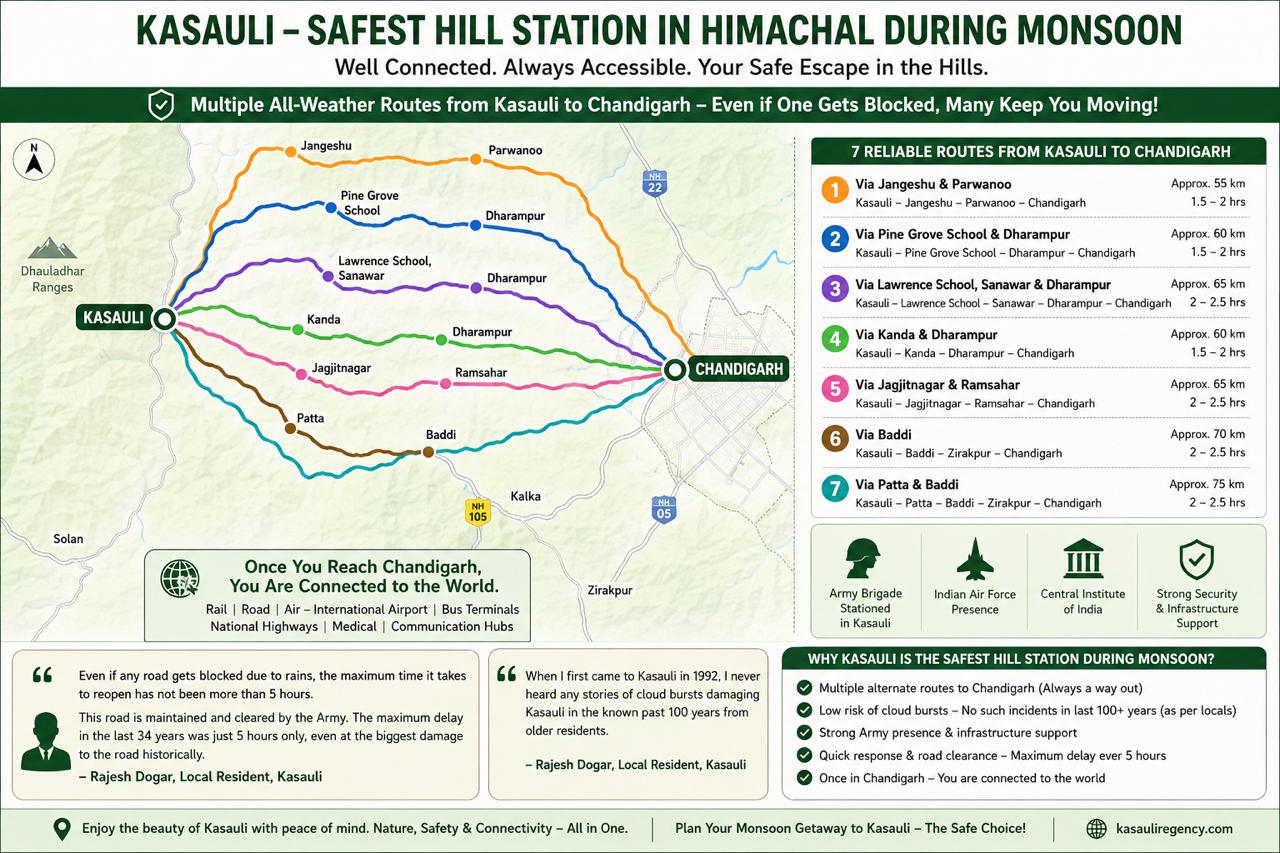
The most commonly used routes connecting Kasauli to Chandigarh include:
- Kasauli → Jangeshu → Parwanoo → Chandigarh
- Kasauli → Pinegrove School → Dharampur → Chandigarh
- Kasauli → Lawrence School, Sanawar → Dharampur → Chandigarh
- Kasauli → Kanda → Dharampur → Chandigarh
- Kasauli → Jagjit Nagar → Ramshehar → Chandigarh
- Kasauli → Baddi → Chandigarh
- Kasauli → Patta → Baddi → Chandigarh
These routes approach Chandigarh through different corridors and road networks, providing multiple options for movement during adverse weather conditions.
How to Reach Kasauli  Via Google Maps
Strategic Infrastructure and Rapid Road Restoration
Kasauli also benefits from the presence of several important national institutions. Authorities have continuously maintained the historic Kasauli Cantonment since the British era, while the town is home to Army establishments, the Indian Air Force station at Monkey Point and the Central Research Institute (CRI), one of India’s oldest public health institutions. This strategic importance has historically ensured strong infrastructure maintenance and a rapid response whenever roads need restoration.
According to Rajesh Dogar, a long-time resident of the Kasauli region since 1992, “Even during the largest road damage incidents witnessed in the area during the past three decades, the maximum delay in restoring connectivity was around five hours.” He further notes that when he first moved to Kasauli, older local residents did not recall any major cloudburst event causing widespread destruction within Kasauli itself.
While travellers should always respect weather conditions in the Himalayas, Kasauli’s hilltop location, extensive drainage network, cantonment infrastructure and multiple evacuation routes make it one of the most resilient and dependable hill stations in North India during the monsoon season.
Most importantly, every major route from Kasauli ultimately reconnects to the Chandigarh Tricity region. Once travellers reach Chandigarh, they gain immediate access to an international airport, major railway stations, national highways, hospitals and modern urban infrastructure. This additional layer of connectivity provides peace of mind that very few hill stations in Himachal Pradesh can offer.
Frequently Asked Question: Can Roads To Kasauli Get Blocked During Monsoon?
Like any hill destination in India, temporary road blockages can occasionally occur during periods of exceptionally heavy rainfall. However, the difference with Kasauli is that travellers are not dependent on a single approach road.
Because Kasauli is connected through Dharampur, Parwanoo, Baddi, Ramshehar, Patta and several local link roads, alternate access routes are often available even when one stretch experiences disruption.
For this reason, Kasauli continues to remain one of the most accessible hill stations near Chandigarh throughout the monsoon season, and travellers seeking a safe mountain getaway without venturing deep into landslide-prone Himalayan valleys frequently prefer it.
Fast Road Restoration, Even If Disruptions Occur
Since Kasauli is home to several important government and defense institutions, road access here isn’t just a tourism priority — it’s a strategic one. Because of this, rapid-response infrastructure teams treat this stretch differently, prioritizing it for repair over routine hill roads. So even if a landslide blocks a route elsewhere in the region, crews restore access here quickly. Tourists benefit directly from this same responsiveness.
Never Get Stranded: Kasauli’s Unmatched Road Connectivity
One of the biggest fears travelers have during monsoon season is getting stuck in a hill station with no way out. However, Kasauli stands apart from every other major hill destination in Himachal here.
Compare the Access Routes
Travelers can reach Manali by only one or two main roads. Similarly, Dharamshala offers just two or three routes. Kasauli, by contrast, connects to the wider region through five to six different roads linking it to Chandigarh, Solan, and Shimla. Therefore, if one route sees temporary disruption, multiple alternatives keep you connected to the rest of the country.
Monsoon Is Actually the Best Time to Visit Kasauli
Beyond safety, monsoon transforms Kasauli into its most photogenic self. Mist rolls through pine forests, waterfalls appear in the nearby hills, and a cool climate offers a refreshing escape from the plains. Pair this with the peace of mind that comes from staying somewhere genuinely safe, and Kasauli becomes the clear choice. Both Indian and international travelers are recognizing this as they search for a reliable monsoon hill station.
More to Explore
🏛️ About Kasauli
Colonial-era charm and quiet streets
❄️ Kasauli Snowfall Guide
Best time to see snow in Kasauli
🌄 Sunrise in Kasauli Hills
Golden Himalayan views every morning
📍 Things to Do in Kasauli
Places of interest near the hotel
🌿 Nature Walks with Vanita
Guided morning walks through Kasauli’s pine forests
🎧 Techno Music Thursdays
Live sets at Hangout Rooftop Bar